Is Seattle’s housing market finally “normal” again? | September 2026 Market Update

Hi, I'm Doron Weisbarth with Weisbarth & Associates, and welcome to my September 2026 Market Update!
So... are we normal again?
The short answer is: I'm not so sure.
August gave us a collection of signals that don't fit neatly into a single story. Some of what happened looked like a pretty normal transition from summer into fall. Other parts were anything but normal.
And rather than try to force all of that into a nice, clean explanation, let me show you what actually happened.

This graph compares what happened in our King County single-family home market from July to August this year with what typically happens during that same period, based on data from the previous ten years.
The blue bars show the change this year, in 2026, and the gray bars show the typical July-to-August changes of years past.
We’re going to look at each one of these measured items more closely, and as you look across these six measurements, you'll see why I'm having a hard time calling August normal.

Let's start with sellers.
New listings dropped 19% from July to August. Now, listings normally decline this time of year, so the fact that they fell isn't particularly surprising. What's unusual is how much they fell. Typically, we'd expect a decline of about 9%. This year, it was more than twice that.
But while sellers were pulling back, buyers actually became more active.
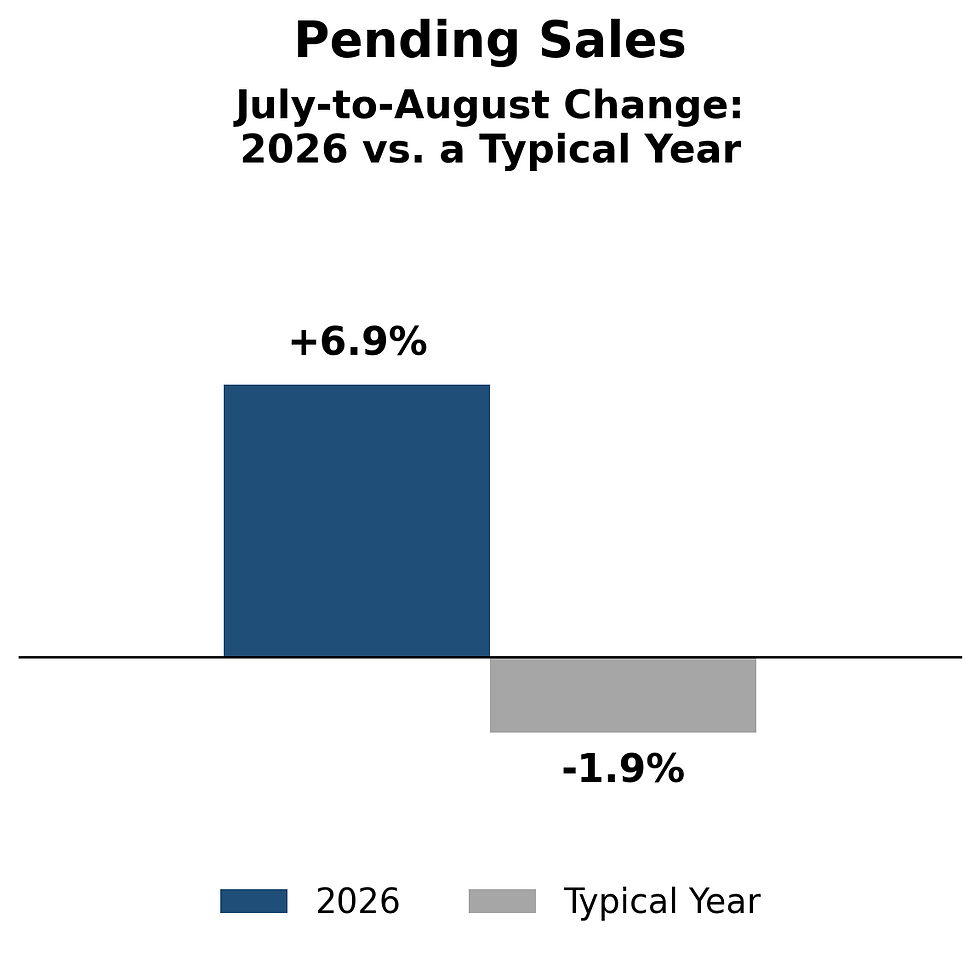
Pending sales — homes that went under contract during the month — increased nearly 7%. Typically, they decline about 2% from July to August.

And we see something similar when we look at showings. Showings per listing increased 7%, compared with essentially no change in a typical year.
So we had fewer new homes coming onto the market, more homes going under contract, and more buyers showing up to see homes for sale.
You might look at those three numbers and think, "Okay, the market is strengthening."
Except... then we get to prices and days on market.

Median prices fell 7.4% from July to August. Again, a decline in August isn't unusual, but typically it's only about 1.4%.

And homes took considerably longer to sell. Median days on market went from 11 days in July to 17 days in August. That's a 55% increase, compared with a typical increase of about 15%. That’s a huge change.

And then, after all of that, look at what happened to the number of homes for sale.
It declined 3.8% — remarkably close to the typical August decline of 2.9%.
So that's August for you.
Fewer sellers. More pending sales. More showings. Lower prices. Longer market times. And, somehow, a fairly normal decline in the number of homes available for sale.
Those things don't necessarily contradict one another. But they also don't give us a nice, clean answer like, "The market is getting stronger," or, "The market is getting weaker."
We can see very clearly what buyers and sellers did in August. What's much harder to tell from one month's data is what was driving those decisions.
One possibility is that lower prices encouraged some buyers to act. Both pending sales and showings increased as prices declined.
But I want to be careful with that explanation because median prices can also change simply because of the mix of homes that happen to sell in a particular month. So just because those things happened at the same time does not mean one event necessarily caused the other.
Another possibility is that we're finally seeing the normal transition into the late summer-early fall market.
Normally, new listings peak in the spring and then decline as we move through summer. But this year, listings remained remarkably steady from April all the way through July. It wasn't until August that we finally saw that drop.
And, of course, several things could be happening at once, which, actually, would not surprise me at all.
Price, selection, interest rates, consumer confidence, individual circumstances — all of those can affect when someone decides it's time to buy or sell.
So August gave us plenty of information about what happened. Figuring out what it all means is going to require a little more time.
By the way, if you'd like to spend a little more time looking at this data and reading the full analysis, you'll find everything in my September newsletter, available online and for download, for free, at Weisbarth dot com forward slash newsletter. That’s Weisbarth dot com forward slash newsletter.
Okay, so what am I going to be keeping my eyes on in the next few months?
Easy — pending sales! Pending sales are one of our better leading indicators because they tell us what buyers are doing right now, rather than closed sales, which tell us what buyers were doing several weeks ago.
And that's what makes September particularly interesting.
If buyer activity remains stronger than its normal seasonal pattern in the coming months, then August may turn out to have been a harbinger rather than an anomaly.
But if it doesn't, then August may simply have been one unusual month. We’ll find out soon enough.
So... are we normal again?
Maybe.
Some familiar seasonal patterns returned in August. Others didn't. And right now, we simply don't have enough information to know whether we're seeing the beginning of a meaningful shift or just one unusual month.
For now, I'd rather watch what happens next than pretend the data is telling us something it isn't.
And if you or someone you know are thinking about buying or selling, uncertainty doesn't necessarily mean you should wait. It means your strategy matters.
At Weisbarth & Associates, we've developed a three-step system for buyers and a five-step system for sellers designed to help our clients make good decisions based on the market we actually have.
If you have questions, specific or general, you can reach out through this website, email me, text me, or, my favorite, pick up the phone and give me a call directly at 206-779-9808. That’s 206-779-9808. I love talking with old friends and new ones, truly!
What’s more, your business and your referrals truly make a difference in our community! Every time we help someone buy or sell a home, we make a donation to Akin, an amazing nonprofit that helps children and families thrive throughout our community.
Thanks for watching. If you find this information helpful, remember to like, subscribe, and follow for more updates. You can also subscribe to my monthly newsletter at Weisbarth dot com forward slash newsletter.
I'm Doron Weisbarth with Weisbarth & Associates. Enjoy the beginning of our fall season, and I’ll see you next month!